Flying with a Baby – Your Practical Guide
How to fly safely and calmly with your baby – from careful preparation through a smooth landing.
TravelFeelings Editorial Team
Your baby’s first flight sits at a strange intersection: you’re excited to show them the world, and you’re also quietly terrified. Will the cabin pressure hurt their ears? Will they scream the entire flight? How on earth will you get through security with all this gear? These questions are real, and the reassuring answer is clear: flying with a baby is far more manageable than most people think.
Age Requirements: When Can Your Baby Actually Fly?
Technically, airlines allow newborns to fly after just 48 hours with a doctor’s letter. In practice, almost every airline permits flights from one to two weeks of age without extra documentation. Here’s the key: airlines allowing it doesn’t make it your best option.
Most pediatricians advise waiting until four to six weeks old. The considered view: if your baby is under three months, you really need a compelling reason. The lungs aren’t fully developed, immune defense is minimal, and you’re sitting in pressurized air with lower oxygen levels. Your newborn simply isn’t built for it yet.
A useful rule of thumb: the older and stronger your baby at departure, the more smoothly the flight goes. Four to six months strikes a reasonable balance between parental wanderlust and your baby’s readiness. Once your baby is more mobile, entirely new possibilities open up — many parents begin beach holidays with their young children once the child hits three to four months old.
The Pediatrician Appointment: Your Most Important Preparation
Schedule it four to six weeks before your flight, not three days before. Your doctor needs time to assess overall health, review vaccinations, and plan any destination-specific shots if needed. Tropical diseases, yellow fever, hepatitis — these require time for immune response. This preparation is essential if you’re planning to fly with your baby to tropical or non-European destinations — a core part of thoughtful family travel planning.
Here’s another key point: if your baby has a cold or ear infection, postpone the flight. A cold in a three-month-old is a genuine respiratory burden, and at altitude it becomes significantly worse.
The Safety Question: Car Seat vs. Lap Infant
The honest answer: the safest option is also the most expensive.
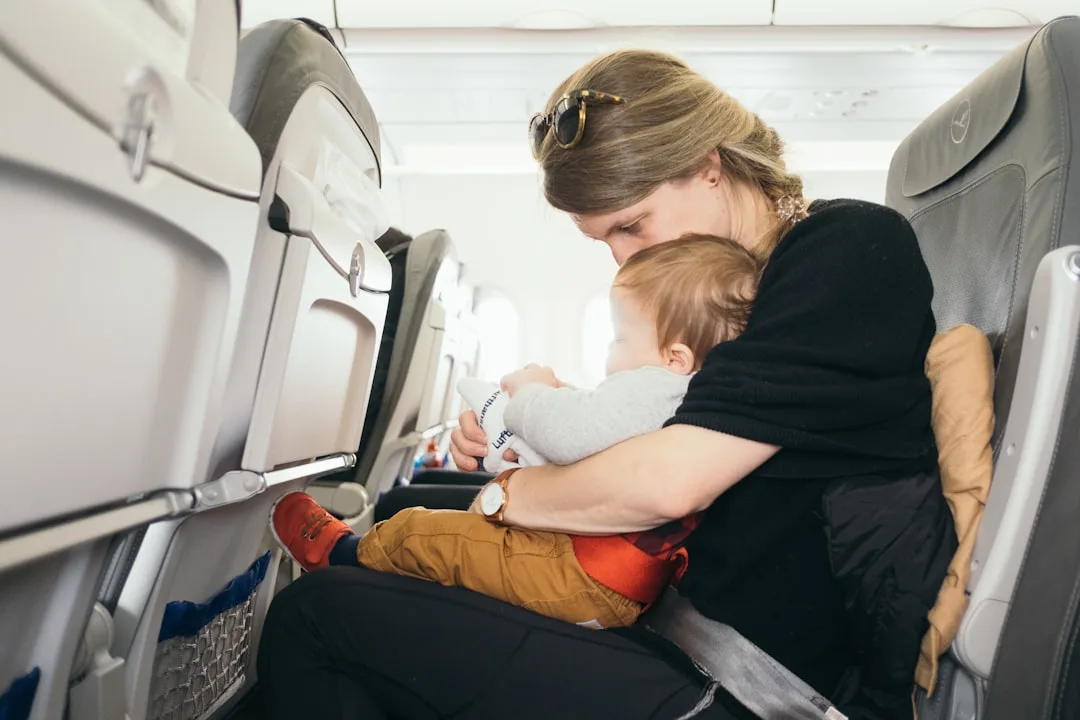
The cheapest route is to fly with your baby on your lap, secured by an extra belt that loops onto your own seat belt. Domestic U.S. flights charge nothing for this; international flights add roughly 10 percent of the adult fare. The trade-off is real. When turbulence hits — and it will — an infant on your lap is far more exposed than one strapped into a proper car seat. FAA research shows parents lose grip strength during rough air, so blame physics — your grip strength simply weakens in rough air.
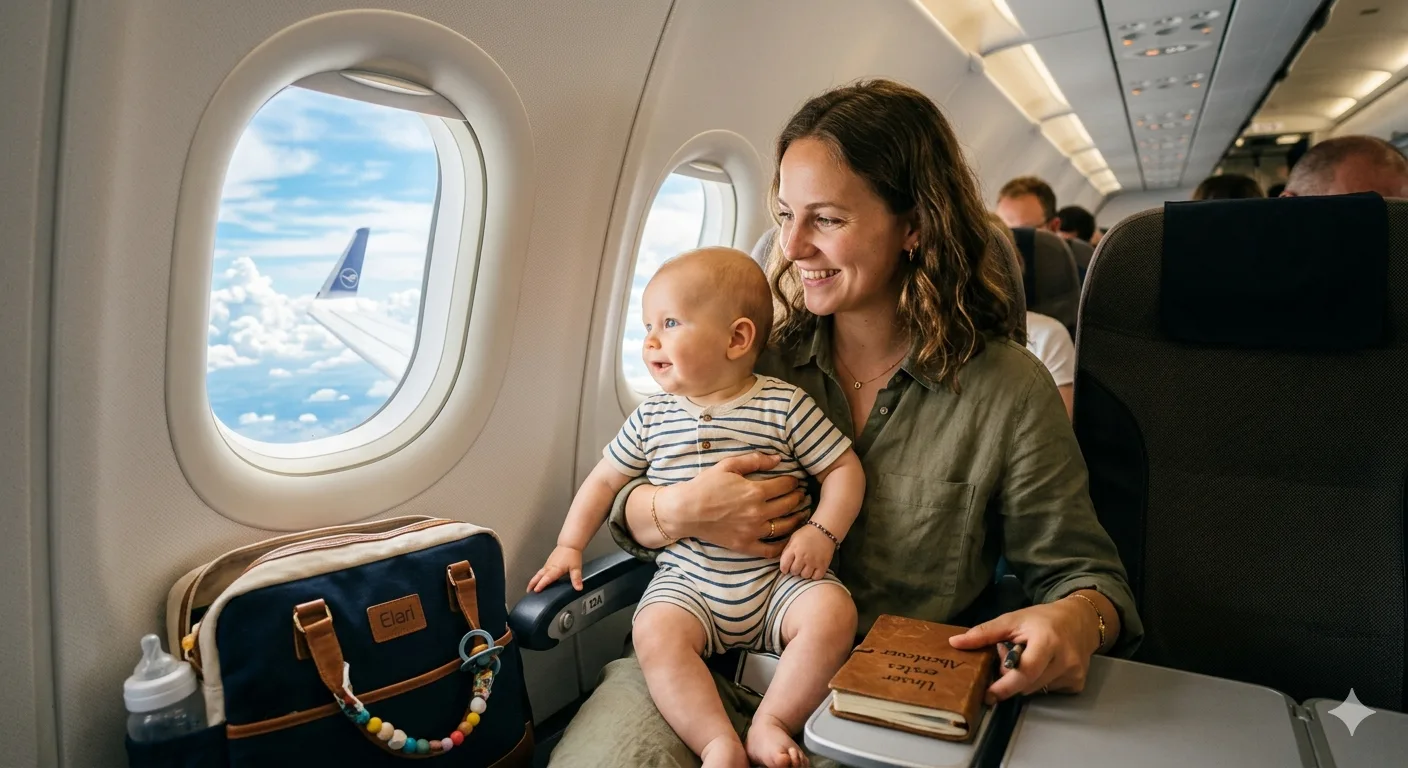
Booking a separate seat with an FAA-approved car seat costs a full adult fare (75 to 100 percent). In return, your baby gets the same crash protection as an adult passenger, and the car seat braces the soft head and spine. Window seats are ideal here: the baby sits close to the wall, away from drink carts and overhead bins.
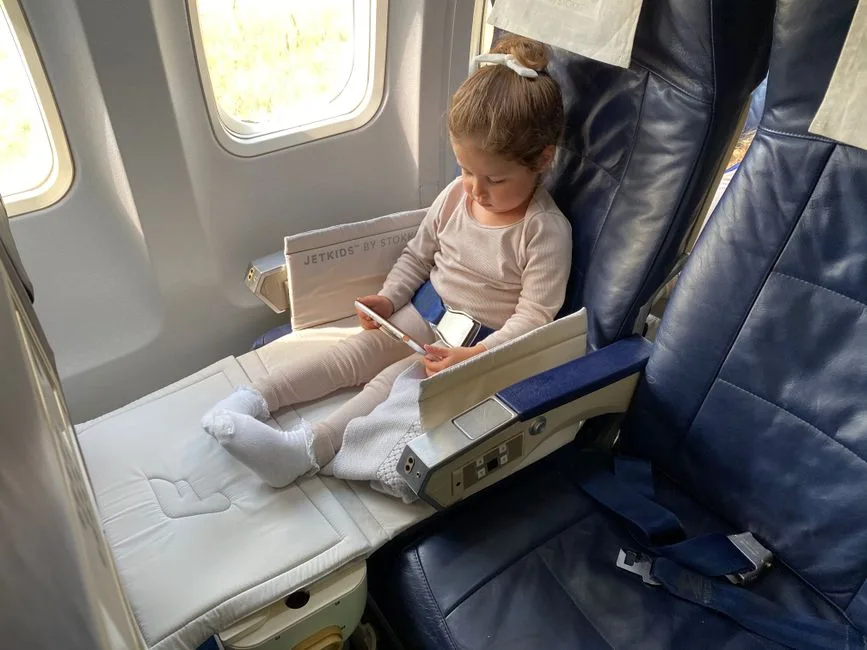
On long-haul aircraft (Boeing 777, 787), some rows have a bassinet that mounts to the wall in front of specific seats, often at no charge. These suit babies up to roughly 20 pounds and 26 inches long, and your baby sleeps in the bed instead of on your lap. Availability isn’t guaranteed — bassinet seats are first-come, first-served and strictly limited — so ask about one when you book.
The recommendation: book a separate seat for flights over two hours. Under two hours, lap travel is workable.
The Most Critical Issue: Ear Pressure and Pressure Equalization
Few things generate more anxiety in parents flying with babies. And honestly, some anxiety is warranted, and a few simple steps take care of it.
The problem: your baby’s Eustachian tube is still immature — shorter, narrower, and far less mobile than an adult’s. When the aircraft climbs or descends, your baby can’t simply yawn and swallow the way you do to equalize pressure. The result is discomfort, sometimes pain, and rarely a minor pressure injury (barotrauma).
But here’s the good news: you can substantially reduce this.
Timing matters most. Don’t wait until the aircraft is already climbing. Start pressure equalization 25 minutes before takeoff and again 25 minutes before landing. The earlier you begin, the better — once the pressure difference grows large, equalization becomes much harder.
Nursing or bottle-feeding is your strongest tool, because sucking triggers swallowing, and repeated swallowing is what equalizes middle-ear pressure. Nurse during takeoff and before landing; if you don’t nurse, offer a bottle. Even a pacifier helps, since continuous sucking activates the same mechanism.
Saline nasal drops earn their place too. Babies breathe almost entirely through their noses in the early months, so a blocked nose means no pressure equalization. About 30 minutes before takeoff and before landing, plain saline drops keep the nasal passages clear — a small measure with real effect.
One thing to avoid: don’t let your baby sleep through takeoff and landing. It sounds counterintuitive when a sleeping baby is usually the goal, but pressure equalization needs regular swallowing, and a sleeping baby won’t swallow on cue. Gently wake them, offer a bottle, and wait until the altitude change is complete.
Most importantly: if your baby has ear pain or a diagnosed ear infection before the flight, postpone. That call is medically sound, since an existing ear infection becomes significantly worse under pressure changes.
Practical Preparation: What You Actually Need
Pack spare clothes for everyone. A diaper leaks, a burping cloth gets soaked, a bottle gets dropped. Bring two complete changes for your baby in your carry-on — onesie, pants, socks — plus at least one shirt for yourself. It sounds minor until you’ve sat for ten hours in wet clothes.
Bring more diapers and wipes than you expect to use. Aircraft have changing tables, but they don’t always stock diapers, so pack enough to cover a full day plus a buffer — delays happen. Wipes pass security without any fuss, since they aren’t classed as liquids.
Baby formula, breast milk, and water for infants are exempt from the 100ml liquid restriction, so bring as much as you realistically need. Don’t rely on the airline: some offer special baby meals, many don’t, and what they do serve your baby often won’t eat anyway. At family-friendly destinations with solid infrastructure you’ll find good alternatives once you land, but your real safety net is familiar food you packed yourself.
Familiar things beat novelties. Pack pacifiers, a couple of favorite toys, and keep the diaper bag organized — a bag you can navigate by feel saves enormous time mid-flight.
During the Flight: Realistic Expectations
To be direct: the first third of your flight is usually manageable. Your baby is curious, might sleep, eats. The second third is trickier. Your baby has registered the environment, boredom sets in, and restlessness emerges whether or not they sleep.
That’s completely normal. The mental shift — telling yourself you’ll likely get three to four hours of fussiness, and that’s fine — helps more than any single trick.
For seating, window seats work best because the baby sits near the wall. Middle seats in three-seat rows give you more room to shift position. Aisle seats get awkward when drink carts pass or passengers stand up often.
Once your baby is a few months old, carry them up and down the aisles. The change of scenery usually calms them faster than insisting everyone stays seated.
A few things simply don’t help. Antihistamines like diphenhydramine aren’t recommended for babies — they can cause side effects and sometimes trigger the reverse reaction in infants, so skip them. Screen time isn’t standard advice for babies under two either. On a long-haul flight, though, a short video can be a lifeline; use it sparingly and without guilt.
Putting It All Together: Your Action Plan
- Four to six weeks before — schedule the pediatrician appointment.
- Four weeks before — decide on a separate seat or bassinet and book accordingly.
- Two weeks before — create the packing list, buy baby food, get saline drops.
- One week before — review all documents (passports, insurance) and call the airline to confirm your bassinet reservation.
- The day before — pack, sleep early, relax.
Flying with a baby takes real preparation, and thousands of parents manage it every day, and the outcome rarely comes down to whether the baby cries. What matters more is whether you’ve prepared for a few hard hours and can accept them as part of the journey.