Museums in Europe: Cultural Highlights & Hidden Galleries
Discover Europe's best cultural museums and galleries beyond the Louvre. Essential institutions and hidden gems across London, Vienna, Amsterdam, and more.
TravelFeelings Editorial Team
The Wallace Collection in London’s West End remains among Europe’s most overlooked museums—yet this free institution offers access to one of the 18th and 19th centuries’ most significant private collections. Upon entering, one must first navigate the curatorial philosophy: The collecting principle itself determines how artworks are displayed. This proves decisive. The Marquess of Hertford assembled the collection between 1760 and 1830—a period when taste and acquisition demonstrated power. At ground level stands a courtyard with bar and restaurant, a refuge from Oxford Street’s commercial intensity. Architecturally, it maintains a Haussmann palace façade while entirely modernizing the interior courtyard.
Yet the classical major museums warrant their reputation. Vienna’s Kunsthistorisches Museum, opened in 1891, demonstrates through spatial arrangement a curatorial principle that resonates today: a dialogue across eras. Egyptian artifacts confront Greek sculptures. Renaissance paintings reflect Baroque gold. Commissioned by Emperor Franz Joseph I, the institution teaches how art history functions as a comparative field.
Amsterdam’s Rijksmuseum presents a phenomenon: though the Rembrandt collection is modest in size, the Night Watch hangs centrally—a 17th-century masterpiece revealing how artists understood commissions as a staged interplay of light and shadow, beyond mere documentation. The Van Gogh Museum beside it displays 200 works by the same artist, yet also enables comparison with contemporaries. Architecture of rationality.
Munich’s Museum Brandhorst fascinates through its façade: 36,000 ceramic rods layering a second skin over steel structure. Architects Sauerbruch Hutton designed a building that responds to sunlight, shifting in hue throughout the day. Inside, the focus remains contemporary art since the 1960s—Pop Art, abstraction, photography. An ambitious exhibition program establishes the house at the center of Munich’s art scene.
Milan’s Fondazione Prada presents something distinct: a collector’s museum of a luxury goods company that refuses appropriation. The buildings encompass a restored 1910 distillery and a new structure by Rem Koolhaas. Bar Luce, the café, was designed by filmmaker Wes Anderson—a film set transformed into public space. The 20th and 21st-century collection remains elegant without becoming a gallery exercise. Notably: entrance is free; the collection is financed by the founding company’s luxury-goods business.
Paris’s Fondation Cartier, opened in 1994, sits within a Jean Nouvel-designed building of nearly complete glass construction. Architecturally, it stakes a position against the massive museum buildings of the previous century. The “Nomadic Nights” program connects visual artists with performers—dance, music, theater occupy exhibition spaces. Paris gained more than another art house here: an experimental field for living cultural production.
Venice’s Gallerie dell’Accademia predates many European nations. Founded in 1756, it holds the world’s most complete collection of Venetian painting—Leonardo da Vinci, Tintoretto, Canaletto, Bellini. Venice itself, architecturally, functions as museum and city constructed from water. The gallery documents this ingenuity in oil and tempera. A palimpsest of centuries.
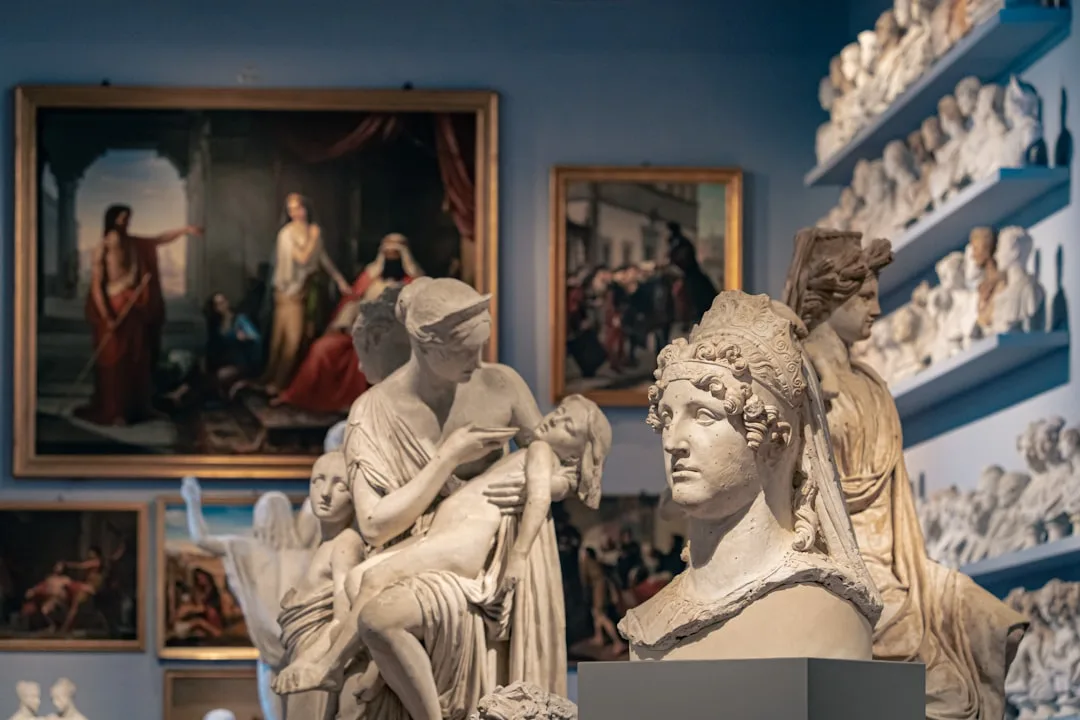
The Museo Gipsoteca Antonio Canova in Possagno, fifty kilometers from Venice, examines Neoclassicism. The sculptor Canova (1757–1822) lived and worked here; his former studio is now a collection of his plaster models and finished works. Architecturally significant: the building reveals how an artist treated the workspace itself as a production site. Plaster casts document artistic process from sketch to finished work.
Frankfurt’s Städel Museum, founded in 1763, ranks among Germany’s oldest art museum foundations. Its building, constructed by David Gilly in the 19th century, demonstrates Enlightenment restraint—simple, restrained, without excess. The collection spans seven centuries of European art. Simultaneously, the house functions as art school, a site of both production and reception. This deserves notice: a museum that teaches as well as collects.
Lisbon’s Berardo Collection, a recent institution (2006), concentrates on modernism and contemporary practice. Warhol, Picasso, Bacon—artists who shaped the 20th century. Architecturally, it occupies a former power plant, renovated by architects Inês Pereira Martins. An industrial brownfield became art space.
Secondary cities often offer deeper engagement. Ghent, Belgium, only thirty kilometers from Brussels, preserves medieval street patterns while hosting one of continental Europe’s most active contemporary art scenes. Prague, with its UNESCO-protected medieval old town, pairs historic architecture with thriving contemporary galleries at significantly lower prices than Western European alternatives. Bologna combines portico architecture with vital street art. Colmar in Alsace presents fairy-tale charm and houses the Unterlinden Museum with Matthias Grünewald’s world-famous Isenheim Altarpiece—art history within arm’s reach.
Lyon serves as Europe’s capital of street art with over 150 large-scale murals. Porto combines historic azulejo tile art with contemporary galleries in the Rua Miguel Bombarda. Kraków offers UNESCO-protected medieval old town with affordable admission to contemporary galleries. Bilbao, famous for the Guggenheim Museum, often overshadows smaller galleries in the Casco Viejo, its historic core.
Immersive art experiences a resurgence in 2026. L’Atelier des Lumières in Paris projects painting across 140 video projectors—an experience oscillating between art viewing and kinetic encounter. Documenta 16 in Kassel will again become continental Europe’s paramount contemporary art exhibition. Vienna celebrates the Albertina’s 250th anniversary with special exhibitions.
To understand Europe culturally, one need not visit all blockbusters. The Wallace Collection in London, Museum Brandhorst in Munich, Fondazione Prada in Milan—these institutions teach how art collecting and architectural space-making converse. Secondary cities like Ghent, Bologna, and Kraków offer more authentic engagement without the crowds of classics. The architecture of these museums constitutes artwork itself. Herein lies a deeper lesson: cultural travel means understanding spatial orders, taste, and power. That remains the education worth undertaking.