Beginner Hiking: Essential Gear and Your First Trails
The 10 Essentials, correct gear choices, and trail selection - start hiking without overspending on equipment you haven't earned yet.
TravelFeelings Editorial Team
Why Hiking — and Why Start Now
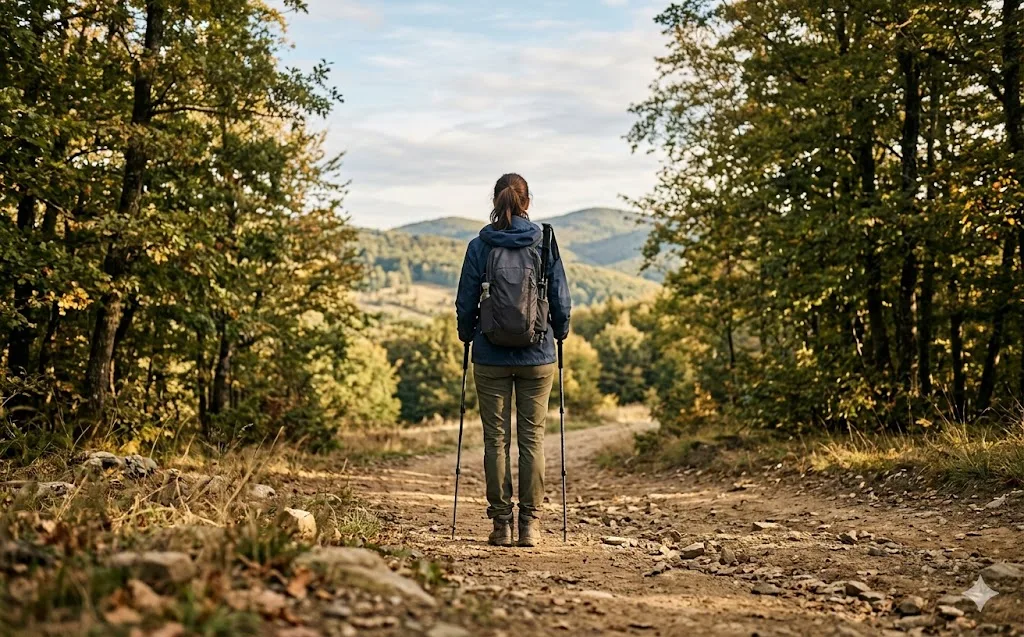
Hiking is not an Instagram aesthetic or a self-discovery narrative. It is simply walking uphill while your lungs work and your mind stops talking. You need sturdy shoes, water, and a plan. You do not need three thousand dollars in gear to start.
Most beginners buy too much before they understand why. That’s the mistake.
The 10 Essentials — A Framework, Not a Dogma
The 10 Essentials are a decision tree: What could go wrong on this trail, and what covers it? An Alpine guide packs differently than a day hiker, but the logic remains.
Navigation starts with paper. A 1:50,000 map weighs 30 grams and needs no batteries. A compass costs $15 (approx. 13 EUR). Smartphones can store offline routes via AllTrails or OSMAnd. No excuses for getting lost — the map was always there.
Sun protection kills quietly. UV intensity at 7,200 feet is unforgiving. Sunscreen SPF 50, a cap, sunglasses. Total cost: $30 (approx. 26 EUR). Essential.
Insulation means layers, not a single thick jacket. That’s physics, not marketing. Merino base layer: $40–60 (approx. 35–52 EUR). Fleece midlayer: $30–80 (approx. 26–69 EUR). Waterproof shell jacket and pants combined: $100–150 (approx. 86–130 EUR). These three systems cover spring through autumn. Cotton is enemy number one — it absorbs water, adds weight, insulates zero once wet.
Illumination: A headlamp costs $20–40 (approx. 17–35 EUR), runs 10+ hours, weighs 3.5 ounces. You won’t need it until you do — and then immediately. Tested: Petzl Tikka.
First aid: A blister kit matters more than antibiotics. Blister patches, ibuprofen, antiseptic wipes, tape. $25 (approx. 22 EUR). Commercial kits are often bloated — assemble your own.
Fire: Waterproof matches, lighter, or tinder. $10 (approx. 9 EUR). Emergency insurance.
Repair tools: A quality multitool (Victorinox or Leatherman) costs $30–80 (approx. 26–69 EUR), weighs 3.5–7 ounces, lasts 20 years. Add duct tape ($5 / approx. 4 EUR) and cord.
Nutrition: Not your lunch, but emergency calories. Trail mix, energy bars, dried fruit. Plan 200–300 kcal per hour. A 1.7 oz bar costs $1–2 (approx. 1–2 EUR) and delivers one hour of steady energy.
Hydration: One liter per hour of hiking is the baseline. A 4-hour hike needs 3–4 liters total. Bottles (each 10 oz) or bladder systems cost $15–40 (approx. 13–35 EUR). In a pinch, any plastic bottle works. Experienced hikers know that hydration management is survival, not comfort.
Emergency shelter: A foil emergency blanket costs $3–5 (approx. 3–4 EUR), weighs 0.7 oz, and preserves core heat. Non-negotiable.
Total for all 10 Essentials in beginner-grade quality: $250–400 (approx. 215–345 EUR). Solid, not luxury.
Hiking Boots — The Foundation
Most beginners fail at step one: wrong footwear. One pair of good hiking shoes is the most expensive and most crucial investment. Budget: $100–200 (approx. 86–173 EUR).
What defines a hiking boot? A lug sole for grip on wet and loose ground. A stiffened heel for stability on steep terrain. Waterproofing — you won’t make three miles without encountering water. Ankle support is optional but useful on scree.
Shop-try, never online-buy. Wear the socks you’ll hike in. Walk around the store for 20 minutes. If blisters form, the shoe is wrong. The right shoe doesn’t pinch.
Common mistake: Buying trail runners or casual sneakers for weight. They work on pavement, not on scree or wet grass. Five kilometers later, blisters appear.
Tested brands: Merrell, Salomon, La Sportiva, Hanwag. All under $150–180 (approx. 129–155 EUR) per pair.
Backpack and Clothing
A day-hike pack needs 15–30 liters. Not 60 — that’s overkill. A solid 20-liter pack costs $60–100 (approx. 52–86 EUR). Padded back panel matters; you’ll sweat. Integrated rain cover is standard.
Good packs: Osprey, Deuter, Salomon.
Pack weight is an art. One extra kilogram is a one-kilometer slog. The rule is basic: hydration, first aid, snacks, rain jacket, map, headlamp — total weight under 18 lbs (8 kg) including water.
Clothing — Layers, Not Garments
Base: Merino or polyester, never cotton. $40–60 (approx. 35–52 EUR). Brands: Odlo, Smartwool.
Mid: Fleece or thin down. $30–80 (approx. 26–69 EUR). Brands: Arc’teryx, Norrøna.
Shell: Waterproof jacket and pants. $100–150 combined (approx. 86–130 EUR). Brands: Salomon, Haglöfs.
Hat: Cap or thin beanie. $20–30 (approx. 17–26 EUR).
Hiking Poles — Optional, But Measurable
Poles reduce knee load by up to 25 percent on descent. That’s measured, not felt. Weight: 1.1 lbs for both. Cost: $40–100 (approx. 35–86 EUR).
Skip until kilometer 15 of your experience. Then decide if you need them.
Planning Your First Trails
Beginners underestimate distance, elevation, and weather. The rule is: start shorter, not longer. Real hiking preparation reveals what works and what doesn’t.
Distance: Begin with 2–3 miles (3–5 km) with zero elevation gain. That’s 45–90 minutes. Seriously. Not ten kilometers at once. Next tier: 8–12 km with 1,000–1,600 feet elevation. That’s 3–4 hours of actual walking.
Elevation gain: Every foot uphill costs twice the energy of flat ground. 1,600 feet over 3 miles is challenging, not casual. Locals don’t mention this because they grew up with it.
Weather: Check the forecast a week out, then three days, then the morning before. Alpine weather shifts in two hours. Thunderstorms develop fast. If rain is forecast, reschedule — don’t ignore it.
Season: June through September in the Alps is safe. Before June: snowmelt and swollen streams. After September: early snow and short daylight.
Navigation: Download offline maps (OSMAnd, AllTrails). GPS devices (Garmin, Suunto) are optional. Minimum: map and compass.
Safety: Tell someone where you’re hiking and when you’ll return. Leave a paper itinerary on the table. In emergency, rescuers know where to look.
Common Beginner Mistakes — Practical
Overpacking destroys morale. Backpack weighs 35 lbs instead of 18. A book, two pairs of shoes, three jackets. By mile two, shoulders ache. By mile four, knees ache. Weight is not adventure, it’s burden.
Inadequate hydration: You notice dehydration too late. Headache, sluggish legs, sour mood — all dehydration. Don’t wait until thirsty. Drink small amounts every 30 minutes.
Navigation blindness: You follow other hikers instead of the map. They go the wrong way. Now you do too. Always hold the map, even on main trails.
Wrong socks: Your daily cotton socks hold moisture, create friction, cause blisters. Hiking socks (merino or wool blend) cost $5–15 (approx. 4–13 EUR) per pair. Buy two pairs.
No breaks: Ten kilometers straight, no water check, no snack stop. You get hungry, slower, miserable. Build in breaks: after 60–90 minutes of walking, stop for 10 minutes. Water and a bar.
Mental blocks: Fear that you’re not fit enough. You are. Every 70-year-old and every 12-year-old with decent shoes can walk five kilometers. Fitness builds through repetition.
Start Realistic
Hiking is not a lifestyle brand. It’s walking uphill while your body works and your mind quiets down. That’s it. You need no bucket-list drama, no profound feelings, no social media story. All the current hiking trends can wait until you know what you actually like.
Your first hike will be uncomfortable. Blisters, sore muscles, boredom. Normal. Not dramatic — adaptation. After five hikes, your body learns. After ten, it’s enjoyable.
Start tomorrow. In your current shoes, with your current pack, five kilometers. Feel it. Then buy the right gear.